
More than 100 days after protests erupted in Pakistan-administered Kashmir, the region is still struggling with a problem that has become almost as persistent as the political crisis that triggered it: restricted access to the internet.
Mobile data and broadband services have remained severely disrupted since unrest began in early June over demands including electoral reform. Although elections were eventually conducted in phases and a new government has taken office, the communications restrictions have continued.
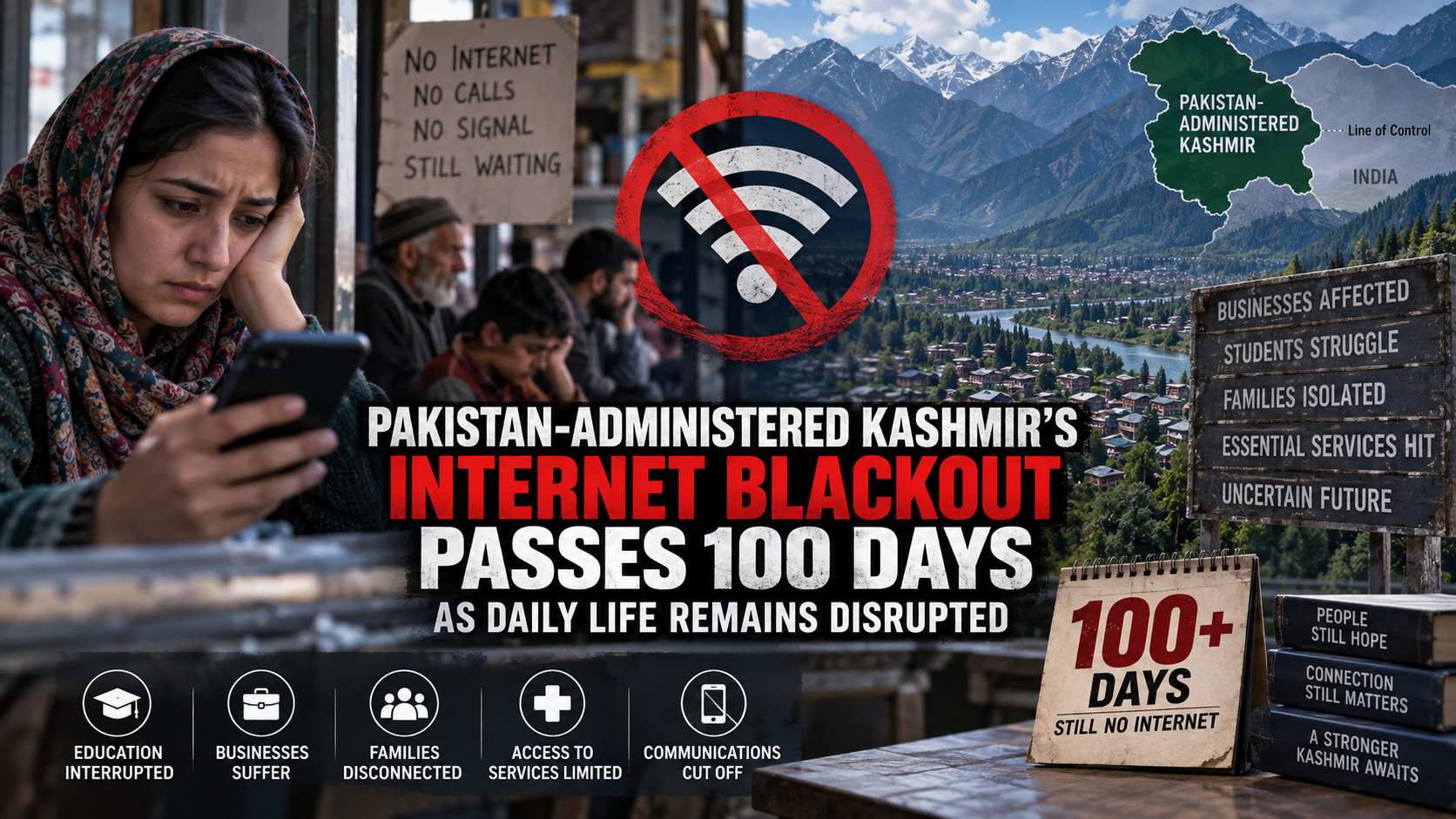
What began as a security measure during a period of unrest has therefore developed into a prolonged communications blackout, affecting ordinary activities ranging from education and business to communication with family members.
A Shutdown That Outlasted the Protests
The protests began in June after disagreements surrounding the region’s electoral system, including demands concerning representation and electoral reform.
The unrest became deadly. Reuters reported in June that at least 24 people had been killed during nearly two weeks of protests, prompting a territory-wide shutdown and major disruption to daily life.
Authorities subsequently proceeded with elections in stages.
The final phase took place on August 10, but the internet restrictions did not disappear with the completion of voting.
That has become one of the central questions surrounding the blackout: if the elections have been completed and a government has been formed, how long should emergency communications restrictions remain in place?
Elections Took Place Under an Internet Blackout
The timing of the shutdown made communications particularly significant.
The region held staggered elections after the unrest, with the final phase taking place in August. Yet residents were still dealing with limited internet access while the political process was unfolding.
For voters, candidates, journalists and civil-society groups, reliable communications can be essential during an election.
Campaign information, announcements, voter coordination and news updates increasingly depend on digital platforms.
A prolonged communications restriction therefore affects more than entertainment or social media. It can influence how quickly people receive information about events taking place around them.
What the Blackout Means for Ordinary Residents
For someone living through a communications shutdown, the consequences can be surprisingly broad.
Students may struggle to access online learning materials. Small businesses can face difficulties communicating with customers and suppliers. People working remotely can lose access to their jobs. Families may have trouble maintaining regular contact with relatives elsewhere.
Modern economies depend heavily on digital connectivity, meaning that an internet shutdown can effectively create another barrier to economic activity.
The consequences become particularly complicated when restrictions continue for months rather than hours or days.
Businesses Face a Different Kind of Disruption
The region’s economy was already affected by the unrest and shutdowns.
When communication networks become unreliable, businesses can find it harder to receive orders, make digital payments, contact suppliers or advertise their services.
A prolonged outage can also affect tourism and other sectors that depend on online information and communication.
The June unrest itself brought much of the region to a standstill, according to Reuters, with roads and markets affected as demonstrations spread.
The continuation of internet restrictions adds another layer to that disruption.
Authorities Cite Security Concerns
Internet shutdowns are often justified by authorities on security grounds, particularly when protests become violent or when officials fear that digital platforms could be used to coordinate unrest.
In this case, the restrictions were introduced after widespread protests and deadly clashes.
That provides the immediate context for the decision.
However, the longer a shutdown lasts, the more difficult the balance becomes between security concerns and the consequences for people who depend on communications networks for everyday life.
Amnesty International has described the internet shutdown as part of a broader crackdown that included arrests and the use of force against protesters.
The Pakistani authorities’ security rationale and criticism from rights organisations represent competing perspectives on the restrictions.
The Information Gap Is Another Concern
An internet blackout does more than prevent people from sending messages.
It can also make it harder for information to circulate.
When residents cannot easily access independent news websites, social-media platforms or messaging services, verifying information during a politically sensitive period becomes more difficult.
That can create an information gap between what is happening locally and what people outside the region are able to understand.
Reporters Without Borders has also raised concerns about restrictions affecting journalism in the region, including internet outages and other measures affecting media access.
Why 100 Days Is Significant
Internet restrictions lasting a few hours during a violent incident are very different from restrictions that continue for more than three months.
Crossing the 100-day mark makes the situation unusual because the original political circumstances have changed.
The protests that triggered the shutdown have subsided sufficiently for elections to take place, and a new government has been formed.
Yet the communications restrictions remain.
That creates a gap between the emergency that prompted the measure and the present-day reality faced by residents.
A Region Trying to Return to Normal
The new government now faces the challenge of restoring ordinary life after months of unrest.
That includes more than reopening roads and markets or rebuilding political institutions.
Communications are part of modern infrastructure.
For schools, businesses, government offices, journalists and families, reliable internet access has become an essential service.
Restoring connectivity could therefore be an important component of returning the region to normality.
The Larger Question: When Should a Shutdown End?
The central issue is not simply whether authorities have the power to restrict communications during a crisis.
It is how such restrictions are reviewed, narrowed and eventually lifted once the immediate emergency has passed.
A temporary shutdown may be introduced because authorities believe there is an urgent security threat. But if the restriction continues after elections and the formation of a new government, residents and rights groups are likely to ask whether the original justification still applies with the same force.
That question is particularly important because the costs of a prolonged blackout accumulate over time.
More Than a Technology Story
Pakistan-administered Kashmir’s 100-day internet shutdown is therefore about much more than smartphones and broadband connections.
It is about how governments respond to political unrest, how elections function when communications are restricted, how businesses survive without reliable digital access and how citizens receive information during periods of uncertainty.
The shutdown also demonstrates how quickly a measure introduced as an emergency response can become part of everyday life.
For residents, the important question now is straightforward:
When will normal connectivity return?
More than 100 days after the restrictions began, that question remains unanswered.
And as the region moves beyond the protests and elections that triggered the crisis, the continuing blackout has become a story in its own right—one that sits at the intersection of security, governance, communication and everyday life.