
Pakistan has suddenly found itself at the center of one of the Middle East’s most complicated diplomatic equations.
Only weeks after Pakistan, Saudi Arabia and Turkiye signed a new mutual-defence agreement in Mecca, the conflict involving Iran, Saudi Arabia and the Iran-aligned Houthis has put the arrangement under its first serious pressure.
The timing is significant. Pakistan has presented itself as both a security partner to Saudi Arabia and a possible diplomatic bridge to Iran. But as attacks against Saudi Arabia intensify, Islamabad faces a difficult question: Can it remain a mediator while also being committed to defending Riyadh?
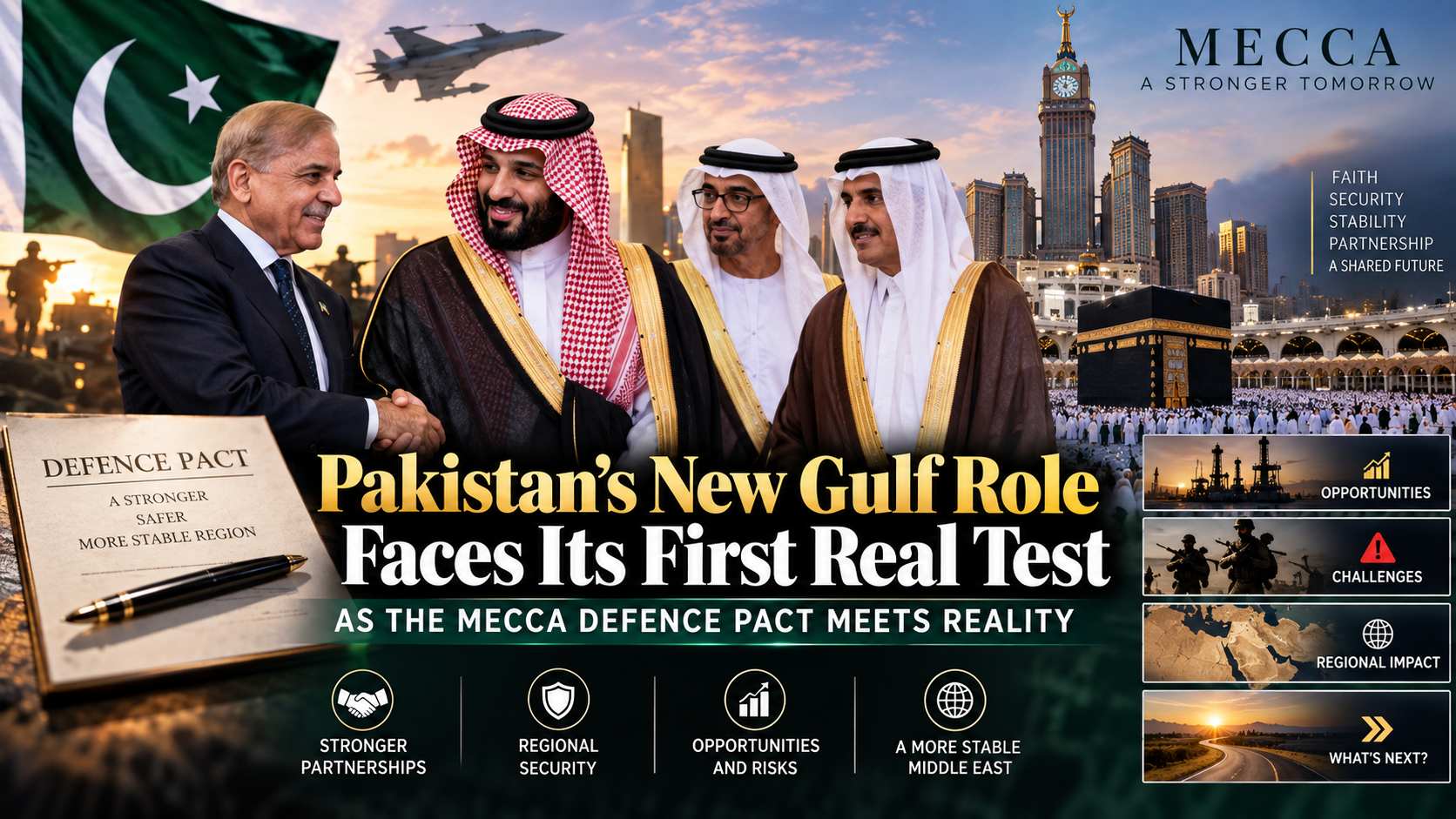
The answer could determine whether Pakistan’s newly increased diplomatic visibility translates into lasting regional influence.
The Mecca Pact Arrived at a Difficult Moment
Pakistan, Saudi Arabia and Turkiye signed the Mecca Joint Defence Agreement on August 7, 2026. The agreement contains an Article 5-style principle under which an attack on one member is treated as an attack on the others.
The pact was presented as a framework for collective defence and deterrence.
But signing an agreement is one thing. Deciding exactly when and how it should be activated is another.
That distinction has become important as Saudi Arabia faces attacks linked to the wider regional conflict.
Pakistan’s Defence Minister Khawaja Asif said on September 9 that there should be no ambiguity about Islamabad’s commitment to the agreement and that aggression against a member could activate its collective-defence provisions.
Yet the following day, Pakistan said there had been no discussion of a military response under the pact to the Houthi attacks.
That apparent tension is at the heart of the current story.
Saudi Arabia Is Facing a New Security Problem
The conflict has created a complicated security environment for Riyadh.
The Houthis, an Iran-aligned movement in Yemen, have intensified attacks against Saudi territory and infrastructure. Recent attacks have reportedly targeted cities and important economic and energy facilities, while Saudi Arabia has carried out strikes against Houthi positions.
The strategic importance of the attacks has increased because the wider war has disrupted traditional energy routes.
With the Strait of Hormuz severely constrained, Saudi Arabia has greater interest in alternative routes toward global markets. The Bab el-Mandeb and Red Sea therefore become even more important.
The Houthis’ position around Yemen’s Red Sea coastline gives the conflict consequences far beyond Saudi-Yemeni relations.
It touches energy security, shipping and the wider global economy.
Pakistan Is Caught Between Two Responsibilities
This is where Pakistan’s position becomes particularly complicated.
On one side is Saudi Arabia, an important economic and security partner. On the other is Iran, Pakistan’s neighboring country with which Islamabad has tried to maintain working diplomatic relations.
Pakistan has also attempted to play a mediating role during the broader US-Iran confrontation.
Reuters reported that Islamabad delivered a warning to Tehran urging it to rein in its Houthi allies as attacks on Saudi Arabia escalated. Pakistani officials have also held talks with Iranian representatives.
That creates a delicate balancing act.
If Pakistan becomes directly involved militarily, its ability to act as a mediator could be reduced.
If it stays entirely outside the military dimension, questions could arise about what its defence commitment to Saudi Arabia actually means.
Neither option is simple.
The Pact Has Not Been Put Into Full Military Action
This is an important distinction that can easily get lost in the headlines.
The fact that Saudi Arabia has come under attack does not automatically mean Pakistan must immediately send forces into combat.
Pakistan’s own officials have described the pact as a deterrent and said there was no military plan in place in response to the Houthi attacks.
The actual text and implementation mechanisms of the agreement are also not fully transparent publicly.
That means the current crisis is effectively testing the space between political commitment and military implementation.
An alliance can promise collective defence while still requiring political decisions about the nature, scale and circumstances of any response.
Why Pakistan’s New Diplomatic Visibility Matters
Pakistan’s increased involvement in Middle Eastern diplomacy did not happen overnight.
Islamabad has longstanding relationships with Saudi Arabia and other Gulf states, while its geographic proximity to Iran gives it an additional diplomatic channel.
The current crisis has placed those relationships under a brighter spotlight.
Pakistan’s military leadership has been involved in discussions with Iranian officials, while Pakistani political leaders have publicly reaffirmed commitments to Saudi Arabia.
That combination gives Islamabad a role that is unusual but also difficult to sustain.
It is trying to remain connected to both sides of a widening regional confrontation.
But Influence Has Limits
Pakistan’s diplomatic activity should not automatically be interpreted as proof that Islamabad has become a decisive power broker in the Middle East.
Mediation requires more than access.
It requires that opposing parties believe the mediator can communicate with both sides, maintain credibility and potentially help produce an outcome that each side can accept.
Pakistan has channels to Tehran and strong ties with Riyadh, but those relationships also create potential conflicts of interest.
Its role in the Mecca pact makes the situation particularly complicated.
A mediator that is simultaneously a formal defence partner of one side has less room to appear completely neutral.
That does not make mediation impossible.
It simply makes it more difficult.
Saudi Arabia Has Other Security Options
Another factor limiting the importance of Pakistan’s role is that Saudi Arabia is not dependent on a single security relationship.
Riyadh has extensive military and diplomatic ties with the United States and maintains relationships with other regional powers.
Recent reporting has also highlighted Saudi efforts to obtain intelligence assistance amid the Houthi threat, including reported coordination involving Israel through US channels.
That means the Mecca pact is one component of a much larger Saudi security network.
Its importance will ultimately depend on what the three members actually build around it—joint planning, intelligence sharing, exercises, defence-industrial cooperation and clearly understood response procedures.
Turkiye’s Position Adds Another Layer
Turkiye is the third pillar of the agreement.
Ankara has said the pact is not directed specifically against Iran. At the same time, Turkish officials have outlined plans for deeper military coordination, including joint exercises and defence-industrial cooperation with Pakistan and Saudi Arabia.
That gives the agreement a broader strategic dimension.
But Turkiye also has its own relationships and interests in the Middle East.
Like Pakistan, it must balance security commitments with diplomatic and economic considerations.
The alliance therefore contains three countries with overlapping interests—but not identical priorities.
The Real Test Is What Happens Next
The current crisis does not prove that the Mecca pact is ineffective.
Nor does it prove that the agreement has already created a powerful new military bloc.
It demonstrates something more useful: the difference between announcing an alliance and making it operational.
If the members develop common command structures, intelligence-sharing arrangements, joint exercises and clearly defined procedures, the pact could gradually acquire greater practical weight.
If those mechanisms remain vague, future crises could produce the same uncertainty now visible around the Houthi attacks.
That is why the next phase may be more important than the signing ceremony itself.
Pakistan’s Balancing Act Is the Bigger Story
For Pakistan, the stakes extend beyond Saudi Arabia.
Islamabad has an interest in maintaining its Gulf partnerships, avoiding escalation with neighboring Iran and preserving its ability to participate in diplomatic efforts.
Those goals can coexist during periods of relative calm.
During a regional war, however, the contradictions become much harder to manage.
The more Pakistan is expected to defend Saudi Arabia, the harder it may become to present itself as an independent intermediary between Riyadh and Tehran.
And the more Islamabad emphasizes mediation, the more questions may arise about how its mutual-defence obligations would work in an actual military confrontation.
From Headlines to Hard Choices
Pakistan’s growing diplomatic role in the Middle East is real in the sense that Islamabad is now participating in important conversations involving Saudi Arabia and Iran.
But visibility is not the same as leverage.
The Mecca defence pact has given Pakistan a formal security commitment to Saudi Arabia and Turkiye. The Iran conflict has simultaneously given Islamabad an opportunity to use its relationships for diplomacy.
The challenge is keeping those two roles from colliding.
The current crisis is therefore less a verdict on Pakistan’s influence than an early stress test of its new regional position.
The most important question is no longer whether Pakistan has become more relevant.
It is what Pakistan can actually deliver when diplomacy and defence commitments pull it in different directions.
For Saudi Arabia, the answer will help clarify the practical value of its new alliance.
For Pakistan, it could determine whether its expanded Middle Eastern role develops into durable diplomatic influence—or remains largely a product of a moment when the region desperately needs intermediaries.