
New Delhi has become the stage for a diplomatic gathering involving some of the world’s most influential emerging powers — but the United States is an unmistakable presence in the background.
As India hosts the BRICS summit, Prime Minister Narendra Modi is bringing together Chinese President Xi Jinping, Russian President Vladimir Putin and leaders from across the expanded grouping at a time of heightened geopolitical and economic uncertainty.
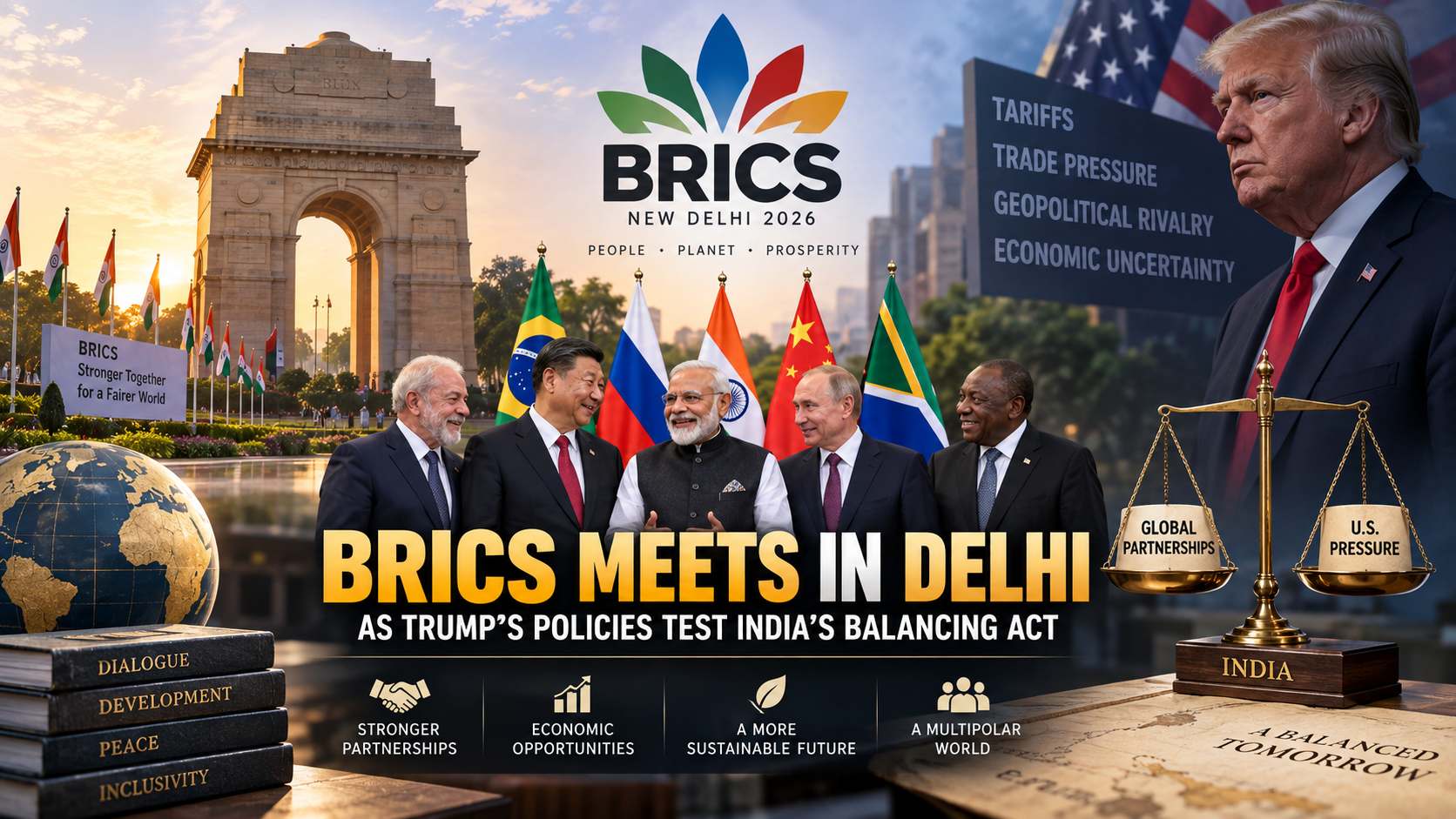
The US is not a member of BRICS. Yet President Donald Trump’s trade policies, pressure on the dollar and approach to countries such as Russia, China and Iran have become part of the wider environment in which the group is trying to define its future.
The central question for BRICS is therefore not simply whether it can challenge Washington.
It is whether countries with very different interests can cooperate closely enough to increase their influence without turning the group into an explicitly anti-American alliance.
India Finds Itself at the Centre of the Conversation
For India, the summit represents a complicated diplomatic balancing exercise.
New Delhi maintains a long-standing strategic relationship with Moscow and continues to cooperate extensively with Russia, including on energy, defence and trade. Modi also held talks with Putin before the summit, with both sides discussing stronger economic and strategic ties.
At the same time, India has substantial economic and strategic interests in its relationship with the United States.
That makes any BRICS declaration targeting Washington directly particularly sensitive for New Delhi.
BBC reporting before the summit noted that India was unlikely to support language that openly attacked the US, while analysts expected criticism of American policies, if included, to be carefully worded.
This balancing act has become one of the defining features of India’s BRICS diplomacy.
Putin and Xi Bring Different Priorities
The presence of Putin and Xi gives the Delhi summit considerable geopolitical significance.
Russia has pushed for BRICS to become a more practical economic platform, with greater cooperation in technology, infrastructure, investment and payment systems. Putin has also argued for reducing the impact of Western sanctions and trade restrictions on BRICS economies.
China, meanwhile, has promoted what Xi calls a broader and stronger BRICS economic partnership.
Xi used the Delhi summit to push initiatives involving areas such as artificial intelligence, trade and economic cooperation.
Both Moscow and Beijing therefore see BRICS as an important mechanism for increasing cooperation outside Western-dominated institutions.
But India does not necessarily share every part of that vision.
BRICS Is Bigger — But Not Necessarily More Unified
The grouping has changed dramatically since its original formation.
BRICS now includes 11 members, giving it a combined population approaching half of the world’s total. Its members also account for a substantial share of global economic activity and international trade.
That expansion has increased the group’s potential influence.
It has also made consensus more complicated.
The members have different political systems, economic interests, security priorities and relationships with the United States.
India and China, for example, have spent years dealing with tensions following their deadly 2020 border confrontation. Although relations have shown signs of improvement, significant disagreements remain.
Iran and the United Arab Emirates also sit within the same expanded BRICS framework despite having been on opposing sides of the wider Middle East conflict.
The summit therefore brings together countries that may agree on some broad principles while disagreeing sharply about individual crises.
The Dollar Question Remains Sensitive
One of the most closely watched issues is the future of the US dollar in international trade.
Some BRICS members have discussed increasing the use of local currencies and developing alternative payment mechanisms. The objective is partly to make trade less vulnerable to sanctions or disruptions in Western financial systems.
But creating a common BRICS currency or rapidly replacing the dollar is a much more difficult proposition.
Trump has previously threatened severe tariffs against countries that support efforts to replace the dollar in international trade. That threat has added another layer of caution for BRICS governments.
Instead of attempting an immediate replacement for the dollar, the group has increasingly focused on practical financial cooperation and greater use of local currencies.
That approach could allow members to deepen economic links without forcing every country into the same geopolitical position.
The New Development Bank Shows What BRICS Can Actually Build
For all the attention surrounding speeches and diplomatic symbolism, BRICS already has one significant institution: the New Development Bank.
The bank has financed infrastructure and development projects and represents one of the clearest examples of BRICS moving beyond political declarations.
Its importance is also connected to the group’s broader ambition to give developing countries greater access to financing without depending entirely on established Western-led institutions.
This is where the practical future of BRICS may be tested.
If the grouping can expand cooperation in infrastructure, technology, trade, energy and finance, its influence could grow even without becoming a formal geopolitical alliance against the West.
Recent Events Have Exposed the Group’s Limits
The summit also comes after a difficult period for BRICS diplomacy.
In May, BRICS foreign ministers were unable to agree on a joint statement following disagreements surrounding the Iran conflict. India, as chair, instead issued a chair’s summary.
That episode illustrates the challenge facing the organisation.
Getting 11 governments to agree on economic cooperation can be difficult enough. Reaching a common position on wars, sanctions and international security is considerably harder.
The Delhi summit therefore carries two parallel stories.
One is about BRICS becoming larger and more influential.
The other is about whether that expansion makes coordinated action harder.
Modi’s Diplomatic Challenge
For Modi, hosting the summit provides an opportunity to bring competing powers into the same room while keeping India’s own relationships flexible.
The meeting between Modi and Xi is particularly significant because India-China relations have been slowly moving toward greater engagement after years of serious tension.
Xi’s visit to Delhi was his first in seven years. The two leaders held talks on the sidelines of the summit and discussed improving bilateral ties, including trade and connectivity.
Putin, meanwhile, remains an important Indian partner.
That places Modi in a position where he can engage simultaneously with Russia, China, Iran and other BRICS members while continuing India’s relationships with Western countries.
The strategy is less about choosing one side and more about maintaining room to manoeuvre.
What Does Washington Make of BRICS?
For the Trump administration, the growth of BRICS is significant because the group potentially offers countries an alternative platform for economic and diplomatic cooperation.
Washington is likely to pay particular attention to efforts involving payment systems, local currencies, trade arrangements and institutions that could reduce dependence on Western financial structures.
But BRICS’ internal disagreements also limit how quickly it can become a unified alternative to the existing international system.
Even members that want a larger role for the Global South do not necessarily agree on what that role should look like.
The Real Test Begins After the Summit
The most important outcome of the Delhi meeting may therefore not be a dramatic announcement.
It may be what member countries are able to implement after their leaders leave the capital.
Can BRICS expand trade among its members? Can it improve cross-border payment systems? Can it finance more development projects? Can India and China continue reducing tensions? And can countries with sharply different views on global conflicts still find enough common ground to act together?
Those questions will determine whether BRICS becomes a more effective institution or remains primarily a forum where governments with different agendas meet.
The Delhi summit demonstrates the group’s growing diplomatic reach. Modi has managed to bring Putin, Xi and other major leaders together at a moment of considerable international uncertainty.
But bringing rivals into the same room is only the beginning.
The bigger challenge for BRICS is turning that gathering into sustained cooperation — without allowing its internal differences to overwhelm its ambitions.